When people picture a robot, they usually picture something big. An arm on a factory floor. A rover on Mars. A surgical system that fills half an operating room. Big robots have the luxury of space. The room can keep the motors away from the electronics, the battery away from the heat, and the sensors away from everything that might interfere with them.
We do not have that luxury. Our robots must fit inside a capsule small enough to be swallowed. That one constraint impacts almost everything about how we engineer.
Every millimeter has a job
Inside our investigational capsules, imaging, movement, power, communications, navigation and computing all compete for the same few cubic centimeters. There is no spare volume. A component earns its place by doing its own job well and by making everything around it possible.
That means shrinking the parts is only the beginning. A part can be small enough on its own and still be the wrong part, because of where its heat goes, how it bends a circuit, what it does to the antenna or how much of the battery it eats. Small is necessary. Small is not sufficient.
Integration is the real challenge
At this scale, every decision is connected to every other decision. The space we give the optics affects the space left for the battery. The battery affects how long the motors can run. The motors affect the electronics that drive them. The electronics affect the heat, and heat affects everything.
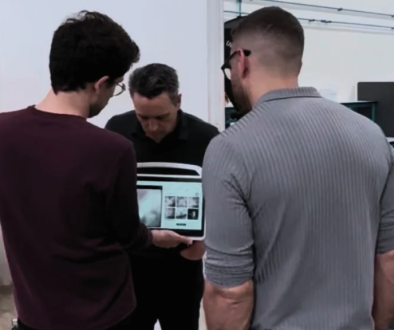
So we do not really design components. We design a capsule, over and over, as a whole. Mechanical design, flexible electronics, optics, assembly, bench testing and iteration are not separate stages handled by separate teams who hand off to one another. They are one conversation, that usually happens standing around an engineering work bench.
Designing for a swallowable capsule
A capsule you can swallow is one of the tightest spaces an engineer can be asked to design for. You cannot add a module when you need a new capability. There is nowhere to put it. Every new function has to be paid for with volume taken from something else, or with an idea that makes two things happen in the space of one.
That constraint has shaped a particular discipline on our team. Cut unnecessary volume without mercy. Question every conventional layout. Ask with every decision what it does to the whole capsule. It is demanding work. It is also the most fun we have had as engineers.
Build. Test. Iterate.
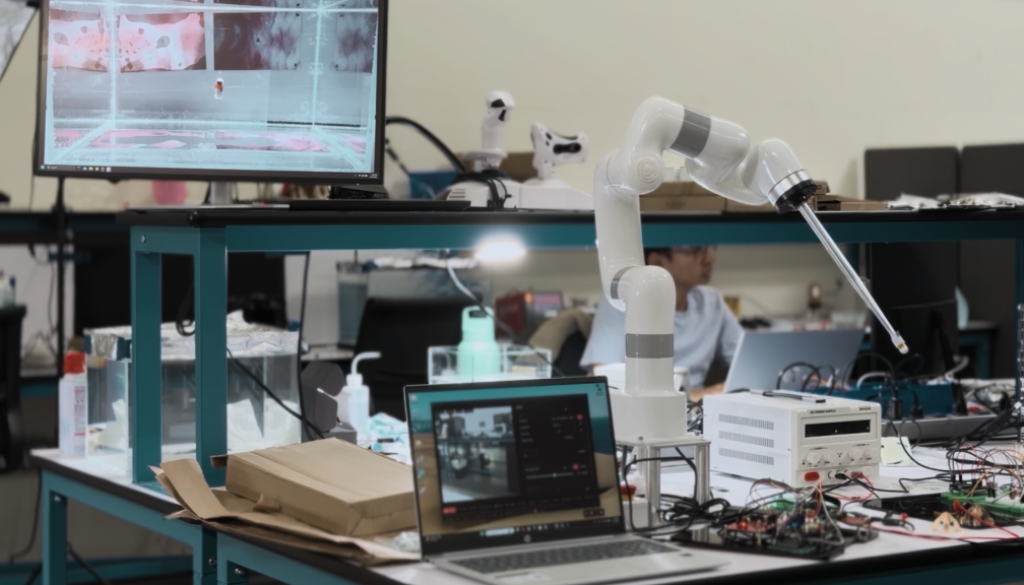
Miniaturized robotics does not get solved on a whiteboard. Designs move constantly between digital models, physical assemblies, test rigs and the bench, as we watch how the pieces behave once they are actually together. Something that looked fine in CAD turns out to block a lens. A flex circuit that should have folded cleanly does not. A power budget that closed on paper does not close on the bench.
Each of those moments is a small gift. It tells us something the model could not. Our development spans mechanical design, electronics, imaging and robotic movement, and every iteration is meant to make the next one wiser. That is how the platform matures: one generation at a time.
Why we think it’s worth it
It would be fair to ask why anyone would sign up for this. There are easier ways to build a robot.
The answer is that size is not a limitation we are working around. Size is the mission. A robot small enough to swallow raises a question we find irresistible which is what could become possible if a complete robot could go wherever a swallowed capsule goes. We do not know the answer yet, and we are careful not to promise one. But that question is why every millimeter is worth arguing over.
Small system. Big thinking.
The defining challenge of capsule-scale robotics is not making technology smaller. It is creating a complete robotic system in a space where nothing is allowed to be extra.
That takes systems-level thinking from the first sketch. Every millimeter matters, because it is part of something much larger than itself.
Arman Nadershahi
CEO
Endiatx