A camera can show you what is in front of it. That is a wonderful thing, and a great deal of modern medicine is built on it. But a camera has one limitation that no lens or sensor can fix. It cannot choose its vantage point.
A robot could change that. Robots are built to move. Put a camera on something designed to move on command, and the question starts to shift from what can I see to what do I want to look at.
That shift is the whole idea behind our investigational swallowable robotic platform.
Seeing comes first
Before anything can navigate a space, it needs information about that space. For us, that begins with real-time, high-quality video.
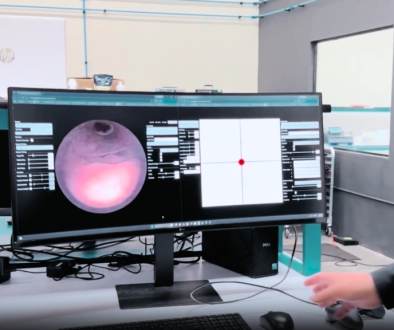
PillVue™ is being developed for real-time upper gastrointestinal visualization. Within our platform it is the foundation layer. Everything we hope to build on top of it depends on getting that first layer right including good lighting, a good lens, a good sensor, and a way to get the picture out of the body and onto a screen while it is still recording. At the scale of a capsule, none of that is a given. If PillVue is cleared by regulators, it would also let us begin working through the practical workflow alongside the doctor’s office, learning how an exam like this fits into scheduling, staffing, and how results get back to the patient chart.
Movement changes the question
Conventional imaging asks: what can the camera see from where it is?
We are asking a different question: could a system change its position, or its angle of view, to capture the perspective a physician is looking for?
PillBot™ is being developed to explore that question by combining real-time video with physician-controlled movement inside the stomach. The design intent is simple to describe. The physician directs where the capsule looks, a little like turning your head to take in a room. We are still working on this to make sure it moves around with ease in the stomach navigating through the natural environment.
Why they must be built together
At capsule scale, navigation is not a feature you bolt on once the camera is finished. It must be engineered together with imaging from the beginning.
Movement, imaging, power, communications and control all share the same few cubic centimeters. Each one makes demands that constrain the others. The motors need power. The camera needs power and light. The radio needs an antenna. All of them have to fit inside something small enough to swallow. Working through those tensions together, rather than one at a time, is what we believe turns a bag of miniature parts into a robotic system.
Why active navigation matters to the platform
To us, active navigation is the step from collecting visual information to collecting it on purpose. That is substantial advancement. A system that could be intentionally moved while capturing images would open the door to capabilities that depend on movement including returning to a spot, holding a view steady, building a sense of where things are. We are still developing those, and we are careful not to get ahead of the evidence. But imaging and navigation are the logical place to begin, because every future capability we can imagine rests on them.
A different kind of camera
The opportunity in robotic medicine, as we see it, is not simply to make a camera smaller. It is to ask what could become possible if a camera were part of a controllable robot, one small enough to swallow and designed to be directed by the person who knows what they are looking for.
That is the engineering problem we are working on: sight and movement, together, at capsule scale.
Arman Nadershahi
CEO
Endiatx